
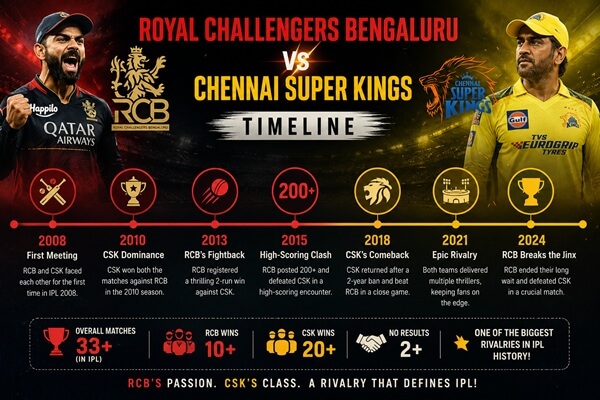
| Chennai Super Kings hold a commanding lead in this fixture, with 21 wins to Royal Challengers Bengaluru’s 14 from 36 IPL meetings and one no result. The two sides have met in an IPL final just once, in 2011, when CSK won by 58 runs. Recent seasons have narrowed the gap sharply: RCB has won four straight meetings since 2025, including a season sweep that broke a 17-year losing streak at Chennai’s home ground, the same year RCB won its first-ever IPL title. |
Few fixtures in the IPL carry as much emotional weight relative to how one-sided the results have actually been. Royal Challengers Bengaluru vs Chennai Super Kings is a rivalry built less on parity and more on contrast: two of the league’s most recognizable captains, two very different team-building philosophies, and a head-to-head record that has only recently started to reflect genuine competitive balance.
This timeline tracks the fixture from its earliest seasons through the 2026 campaign, marking the results, streaks, and individual performances that turned a lopsided rivalry into appointment viewing every single season.
The Rivalry at a Glance
Track Your Order
| Metric | Figure |
| Total IPL meetings | 36 |
| Chennai Super Kings wins | 21 |
| Royal Challengers Bengaluru wins | 14 |
| No results | 1 |
| Only final meeting | 2011, CSK won by 58 runs |
| Highest team total | CSK, 226 |
| Lowest team total | RCB, 70 (2019, Chepauk) |
The Timeline
| 2008 | The Fixture BeginsRoyal Challengers Bengaluru and Chennai Super Kings met for the first time in the IPL’s inaugural season. Both franchises were still building their core identities, but an early pattern was already visible: Chennai’s calm, structured approach under MS Dhoni began outperforming RCB’s star-studded but less settled batting lineup in the fixture’s opening seasons. |
| 2009 | A Statement Win in JohannesburgWith the IPL relocated to South Africa that year due to general elections in India, CSK delivered the biggest winning margin in the fixture’s history, a 92-run victory over RCB in Johannesburg. The result underlined how thoroughly Chennai had settled into its identity, performing just as effectively away from familiar conditions as at home. |
| 2011 | The Only Final These Two Have Ever PlayedCSK and RCB met in the IPL final for the first and only time, at the MA Chidambaram Stadium in Chennai. Batting first, CSK posted 205/5, built around Murali Vijay’s 95 off 52 balls. RCB’s chase collapsed early, with Chris Gayle out for 0, and despite a fighting 35 from Virat Kohli, RCB were bowled out for 147. CSK won by 58 runs, becoming the first franchise to successfully defend an IPL title, while RCB’s defeat became a defining chapter in the club’s long wait for a maiden championship. |
| 2012-2014 | A Competitive Middle StretchResults between the two sides stayed closer to even during this period than the fixture’s overall history might suggest, with both teams trading wins across league fixtures. RCB’s batting depth, anchored by Chris Gayle and a young Virat Kohli, kept these matches high-scoring, even as Chennai continued to find ways to close out tight finishes more consistently than their opponents. |
| 2015 | A Clean Sweep for ChennaiCSK won all three meetings against RCB that season, including a playoff clash, extending a pattern of season-long dominance that would recur throughout the mid-2010s. Individual performances from RCB were not enough to offset Chennai’s consistency across the full campaign. |
| 2016-2017 | A Pause in the RivalryChennai Super Kings did not compete in the IPL during the 2016 and 2017 seasons following a suspension connected to a separate spot-fixing case involving the franchise’s ownership. The break meant no meetings between the two sides for two full seasons, before CSK’s return to the tournament in 2018 picked the rivalry back up almost immediately with one of its most dramatic individual performances. |
| 2018 | Dhoni’s First Great EscapeChasing 206 at the M. Chinnaswamy Stadium in Bengaluru, CSK slipped to 74/4 after nine overs before MS Dhoni produced an unbeaten 70 off just 34 balls, including seven sixes, to complete an unlikely win. The innings became one of the most replayed individual performances in the fixture’s history. |
| 2019 | Heartbreak in Bengaluru, Collapse at ChepaukThe two sides produced two of the fixture’s most dramatic results in the same season. At the Chinnaswamy, chasing 162, Dhoni again went on the attack late, scoring an unbeaten 84 off 48 balls with 24 runs off the final over alone, but CSK fell one run short. Later in the season at Chepauk, RCB collapsed to just 70 all out, the lowest total either side has posted in the fixture’s history, undone by conditions that increasingly favored Chennai’s spin-friendly setup as matches progressed. |
| 2015-2021 | Chennai’s Longest Stretch of ControlAcross this period, CSK won ten of thirteen meetings against RCB, the most dominant stretch either side has produced in the fixture’s history. The scale of that run reinforced the perception that this was fundamentally an uneven contest, a framing that would hold until RCB’s results began shifting several seasons later. |
| 2025 | RCB Breaks Through, TwiceRoyal Challengers Bengaluru swept both meetings against Chennai for the first time in the rivalry’s history. The signature result came at Chepauk, where RCB won by 50 runs, breaking a seventeen-year losing streak at a ground long considered Chennai’s fortress. The same season, RCB won its first-ever IPL title, beating Punjab Kings in the final, adding new context to a rivalry long defined by RCB’s search for a first championship. |
| 2026 | The Streak Extends to FourRCB opened the 2026 season as defending champions and carried that form directly into this fixture. In their season opener against Sunrisers Hyderabad, RCB completed the fastest 200-plus run chase in IPL history, finishing in 15.4 overs behind Virat Kohli’s unbeaten 69 and Devdutt Padikkal’s 61 off 26 balls. When RCB and CSK met in April, RCB extended their run over Chennai to four consecutive wins, narrowing the all-time head-to-head to 21-14 with one no result across 36 meetings. |
Standout Performers
| Category | Leader | Total |
| Most runs (RCB) | Virat Kohli | 1,100+ runs |
| Most runs (CSK) | MS Dhoni | 800+ runs |
| Most wickets (CSK) | Ravindra Jadeja | 18 wickets |
| Second most wickets (CSK) | Dwayne Bravo | 17 wickets |
Why Chepauk Has Mattered So Much
A large share of Chennai’s historical advantage in this fixture traces directly back to home conditions. At the MA Chidambaram Stadium, CSK has historically won roughly eight of every ten meetings against RCB, a gap wide enough to shape the entire narrative of the rivalry for over a decade. Pitches that increasingly assist spin bowling as a match wears on have consistently played to Chennai’s strengths, built around specialist spinners and a batting lineup comfortable playing turn late in an innings.
That is precisely why RCB’s 2025 win at Chepauk carried so much weight. It was not just a rare away win against a strong opponent, it was a result at the one venue that had defined the power imbalance in this fixture more than any other single factor. Breaking a streak that had lasted seventeen years meant breaking the specific advantage that made this rivalry feel one-sided in the first place, rather than just picking up an isolated victory on a given day.
It is worth noting that the reverse fixture, played at RCB’s home ground in Bengaluru, has told a noticeably different story. The Chinnaswamy has been the site of several of the rivalry’s most dramatic finishes, including both of Dhoni’s signature 2018 and 2019 innings, suggesting that Bengaluru’s flatter, higher-scoring conditions have historically produced closer contests than Chennai’s spin-friendly surface, even in seasons where Chennai has won the head-to-head battle overall.
Two Franchises, Two Building Philosophies
Beyond individual results, this fixture has long served as a useful case study in contrasting approaches to team-building. Chennai Super Kings built its identity around continuity, retaining a core group of players and a settled leadership structure across more than a decade, which paid off most visibly in tight, low-scoring finishes where composure under pressure decided the outcome. Royal Challengers Bengaluru, for most of its history, leaned toward assembling the most explosive available batting talent, even when that came at the cost of squad balance in other areas, particularly bowling depth.
That contrast is part of why RCB’s 2025 title, arriving in the same season as its breakthrough against Chennai, felt significant beyond the scoreline. It coincided with a broader shift in how the franchise built its squad, placing more emphasis on balance across bowling and fielding rather than relying primarily on star batting power, a shift that mirrors, in some ways, the identity Chennai spent over a decade building.
Common Misreadings of This Rivalry
- Treating the all-time head-to-head record as a reflection of current form, when four of the last five meetings have gone RCB’s way.
- Assuming RCB’s recent wins are isolated upsets rather than part of a broader shift that includes a maiden IPL title in 2025.
- Overlooking how much of Chennai’s historical edge is tied specifically to Chepauk, rather than a general superiority across all venues.
- Underrating Dhoni’s individual statistical impact in the fixture simply because CSK’s team results have softened in the most recent seasons.
Also read: AC Milan vs SSC Bari Timeline
What’s Next for the Fixture
With both franchises now holding IPL titles and RCB carrying a genuine winning streak into 2026, the emotional stakes of this fixture have shifted from RCB chasing legitimacy to two champions defending recent form. Whether Chennai can reassert its historical control, particularly at Chepauk, or RCB’s current run marks a lasting change in the balance of power, is likely to be one of the more closely watched storylines of the next several IPL seasons. Either way, a fixture once defined mainly by its lopsided history now carries genuine uncertainty heading into every meeting, which is exactly the kind of shift that keeps a rivalry relevant long after the record books stop telling the whole story.
Frequently Asked Questions
Who leads the head-to-head record between RCB and CSK?
Chennai Super Kings lead with 21 wins to RCB’s 14 from 36 IPL meetings, with one match ending in no result.
Have RCB and CSK ever met in an IPL final?
Yes, only once, in 2011, when CSK won by 58 runs at the MA Chidambaram Stadium to become the first franchise to defend an IPL title.
What is RCB’s lowest score against CSK?
RCB were bowled out for 70 at Chepauk in 2019, the lowest total either side has posted in the fixture’s history.
Why has Chennai historically dominated this fixture at home?
CSK has won roughly eight of every ten meetings against RCB at Chepauk, helped by pitches that increasingly favor spin bowling as matches progress, a condition that consistently suits Chennai’s team-building approach.
Has the balance of the rivalry changed recently?
Yes. RCB has won its last four meetings against CSK, including a season sweep in 2025 that ended a seventeen-year losing streak at Chepauk.
Who are the leading run-scorer and wicket-taker in this fixture?
Virat Kohli leads all batters with more than 1,100 runs for RCB, while Ravindra Jadeja leads all bowlers with 18 wickets for Chennai.
Did either team win an IPL title around the time the rivalry shifted?
Yes. RCB won its first-ever IPL title in 2025, the same season it swept both meetings against Chennai for the first time in the fixture’s history.
What was the biggest winning margin in this fixture’s history?
Chennai’s 92-run win over RCB in Johannesburg during the relocated 2009 season remains the largest winning margin either side has posted.