Track Your Order
Complete Match History
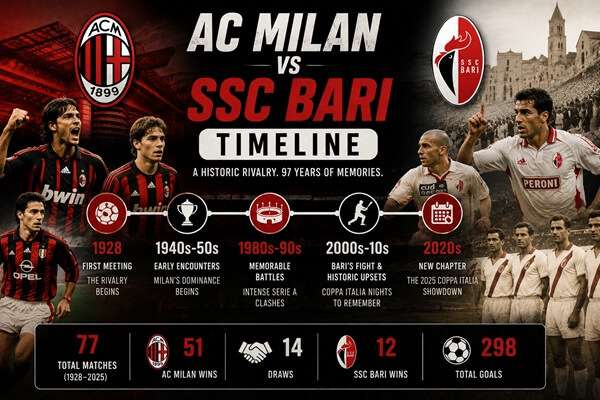
AC Milan vs SSC Bari Timeline
77 official matches from 1928 to 2025. A northern giant and a southern fighter — one of Italian football’s most instructive long-form stories, told era by era.
77Matches
51Milan Wins
13Bari Wins
13Draws
9–1Biggest Win
Quick Answer
The AC Milan vs SSC Bari timeline spans 77 official matches from 1928 to 2025 across Serie A and Coppa Italia. AC Milan lead the head-to-head 51–13 with 13 draws, having scored 182 goals to Bari’s 64. Their most recent meeting was the Coppa Italia Round of 64 on 17 August 2025, which Milan won 2–0 through goals by Rafael Leão and Christian Pulisic at Stadio Giuseppe Meazza.
The fixture between AC Milan and SSC Bari is not defined by constant confrontation or derby-level hatred. It is defined by something more nuanced — the cyclical collision of a club built for European glory and a club built on regional pride, financial resilience, and the will to simply belong at the highest level. When these clubs meet, the context has always been unequal. Milan enter with expectation; Bari enter with everything to prove.
That contrast is what makes the AC Milan vs SSC Bari timeline one of Italian football’s most compelling long-form stories. Across nearly a century, the fixture has produced record-breaking thrashings, famous underdog victories, moments of individual brilliance, and the extraordinary story of a southern club that refused to fade even when the money ran out and the league tables said it was time to disappear.
This article traces every significant chapter — era by era, match by match, story by story — from 1928 to the latest Coppa Italia encounter in 2025.
Head-to-Head Record
The Numbers That Define This Fixture
All official competitive matches — Serie A and Coppa Italia — from 1928 to August 2025.
77Total Matches
51AC Milan Wins
13Bari Wins
13Draws
| Statistic | AC Milan | SSC Bari |
|---|---|---|
| Total Wins | 51 | 13 |
| Goals Scored | 182 | 64 |
| Average Goals per Match | 2.36 | 0.83 |
| Home Win Rate | Over 90% | Best results at Stadio San Nicola |
| Biggest Win | 9–1 (1949, Serie A) | — |
| Draws | 13 draws across both competitions | |
| Most Recent Match | 17 Aug 2025 — Coppa Italia (Milan 2–0 Bari) | |
Historical Context
Bari’s 13 victories carry enormous emotional weight in Galletti folklore — each one came against a Milan side operating at or near the peak of Italian football. The win percentage favours Milan overwhelmingly, but the fixture’s narrative has always been shaped by the occasions when Bari refused to follow the expected script.
Era by Era
Multiple Stories Across One Century
Each decade of this fixture produced a distinct chapter with its own cast, context, and defining results.
1928 to 1950
The Beginning: First Meetings and a Record Rout
The two clubs first met officially in 1928, with a draw suggesting competitive balance that would not last long. Milan grew in authority through the 1930s as the Italian league structure consolidated. Home advantage was a genuine factor throughout this era, keeping scores tighter than Milan’s quality suggested. The defining result of this entire period — and of the whole fixture — arrived on 18 December 1949: Milan 9–1 Bari, the largest winning margin ever recorded between these clubs. It remains the benchmark result to this day.
Record: Milan 9–1 (1949)
1950s to 1960s
Milan’s Authority Meets Southern Resistance
Milan dominated almost every encounter but Bari were rarely passive. At Stadio San Nicola, matches became emotionally charged affairs where crowd pressure produced brief periods of genuine competition. Bari’s approach was pragmatic — deep defensive lines, physical pressing, and fast transitions on the break. Occasional draws at Bari’s ground were celebrated as moral victories. The era established the pattern this fixture would follow for decades: Milan in control, Bari fighting for every minute, and the scoreline rarely telling the full story of what happened on the pitch.
Pattern Established
1970s to 1980s
Gianni Rivera, Tactical Battles, and a Famous Shock
Gianni Rivera led Milan’s creative play through the 1970s, and the Rossoneri remained a domestic powerhouse. Then came the moment Bari supporters still reference: a famous 1978 home victory that sent shockwaves through Italian football and gave southern supporters an emotional reference point they still celebrate. The 1980s brought a different challenge — Milan with Marco van Basten and Franco Baresi was an entirely different proposition. The 1986 fixture confirmed it: Milan 5–0, a statement of complete attacking superiority. But the 1978 win lived on as proof that the impossible was possible.
1978: Bari Shock Milan at Home
1987 to 1998
Golden Era Milan vs a Defiant Bari
Under Arrigo Sacchi and later Fabio Capello, Milan became near-unstoppable. High-press football, world-class personnel, and total tactical clarity made them one of the finest sides in European history. Yet Bari kept competing. In 1987, Bari beat Milan 2–1 at Stadio San Nicola — a result that shocked the football world and remains one of the proudest chapters in Galletti history. On 14 January 1998, a Coppa Italia knockout clash ended 2–1 to Milan, settled by a Marco Simone late winner that kept a packed crowd talking for weeks. Bari’s defensive resilience against the era’s best squad is what defines this chapter.
1987: Bari 2–1 AC Milan
Early 2000s
Ancelotti’s Milan, Ronaldinho, and the Last Serie A Meetings
Carlo Ancelotti arrived and shifted Milan toward European ambition while maintaining domestic authority. Andriy Shevchenko, Kaká, and later Ronaldinho brought unprecedented attacking quality to the Rossoneri. Bari, struggling to maintain top-flight stability, fell back into the lower divisions. The encounters of this era were increasingly one-directional. On 25 April 2009, Ronaldinho scored twice in a 4–1 hammering that showcased Milan’s quality gap at its widest. These matches would prove to be the final regular Serie A fixtures for many years as Bari’s league position began to falter.
2009: Milan 4–1 (Ronaldinho ×2)
2009 to 2011
Bari’s Short Return and the Greatest Modern Upset
Bari earned promotion to Serie A ahead of the 2009–10 season, reopening the fixture for a brief but significant two-year spell. Their first encounter ended 0–0 in Bari — a disciplined, hard-earned point. Financial pressures were already building behind the scenes. Then came 7 November 2010: Bari’s most celebrated modern result, winning 3–2 at the San Siro in a result that stunned Italian football. The comeback win was everything Galletti football stands for. By 2011, financial collapse forced Bari into relegation and a painful rebuild. The fixture disappeared from Serie A again — this time for over a decade.
Nov 2010: Bari Win 3–2 at San Siro
Key Moments
The Defining Results of the Entire Timeline
1928
First Official Meeting — Serie A
The two clubs meet for the first time in competitive football. A draw in the early encounter hints at Bari’s refusal to be passive against bigger opponents.
Draw
1949
AC Milan 9–1 SSC Bari — Serie A
18 December 1949. The largest winning margin in the history of this fixture. The record result has stood for over 75 years and remains the defining statistic of this head-to-head.
Milan 9–1 Bari
1978
Bari Shock Milan at Stadio San Nicola
A famous home win that sent waves through Italian football. Southern pride, a partisan crowd, and a performance above Bari’s expected level combined to produce the era’s defining upset.
Bari Win
1986
AC Milan 5–0 SSC Bari — Serie A
Van Basten-era Milan at their most complete. A display of total attacking dominance that reflected the gulf in class between the two sides during this golden period for the Rossoneri.
Milan 5–0 Bari
1987
SSC Bari 2–1 AC Milan — Serie A
Bari win at home against one of Italy’s finest squads. A result that shocked the football world and remains one of the proudest chapters in Galletti history. Fans still reference this result decades later.
Bari 2–1 Milan
1998
AC Milan 2–1 SSC Bari — Coppa Italia (14 Jan)
A tense knockout tie sealed by a Marco Simone late winner. The match kept a packed crowd on its feet until the final whistle and demonstrated Bari’s ability to compete in cup football against elite opponents.
Milan 2–1 Bari
2009
AC Milan 4–1 SSC Bari — Serie A (25 Apr)
Ronaldinho at his flamboyant best, scoring twice in an emphatic home win. One of the most entertaining encounters in modern fixture history, showcasing the gap in squad quality during this period.
Milan 4–1 Bari
2010
AC Milan 3–2 SSC Bari — San Siro (7 Nov)
Bari win 3–2 at the San Siro in what became the most celebrated modern result in this fixture. The comeback victory at one of football’s most iconic venues was everything Galletti football represents — spirit, belief, and refusal to accept the expected outcome.
Bari Win 3–2 at San Siro
2025
AC Milan 2–0 SSC Bari — Coppa Italia Round of 64 (17 Aug)
The most recent meeting. Rafael Leão opened the scoring in the 14th minute before Christian Pulisic added a second just after halftime. Milan dominated with 65% possession and an xG of 2.41 vs 0.29. Attendance: 71,061 at Stadio Giuseppe Meazza.
Milan 2–0 Bari
Most Recent Match
August 17, 2025 — Coppa Italia Round of 64
Coppa Italia — Round of 64 — Stadio Giuseppe Meazza, Milan
AC Milan
Serie A
2 – 0
FT
SSC Bari
Serie B
65%Milan Possession
2.41Milan xG
0.29Bari xG
24 vs 6Total Shots
71,061Attendance
8.6Pulisic Rating
Rafael Leão opened the scoring in the 14th minute before Christian Pulisic added a second just after halftime, earning a Player of the Match rating of 8.6. Leão was forced off with an injury before halftime, casting a shadow over an otherwise comfortable performance. The referee was Alberto Ruben Arena, conditions were warm at 28°C, and the game was played on grass at 89% stadium capacity.
The fixture marked the first time these clubs had met since the 2010–11 Serie A season — a 14-year gap caused primarily by Bari’s financial collapse and subsequent years in the lower divisions. The Coppa Italia provided the bridge back to an encounter many supporters on both sides had waited years to see again.
Player Legends
The Names Who Shaped This Fixture
From golden-era icons to modern match-winners — the individuals who defined each chapter of this timeline.
AC Milan — All-Time Legends
1Marco van BastenStriker — Golden Era
2Franco BaresiCentre-back — The Captain
3Andriy ShevchenkoStriker — 2000s Era
4RonaldinhoAttacking MF — 2009 double
5Paolo MaldiniDefender — Club legend
6KakáMidfielder — Ancelotti era
7Marco SimoneMF — 1998 Coppa winner
8Rafael LeãoWinger — 2025 scorer
9Christian PulisicMF — 2025 POTM (8.6)
10Zlatan IbrahimovićStriker — Icon
SSC Bari — Galletti Icons
1Antonio CassanoBari academy product
2Igor ProttiStriker — Serie A era
3Marco BorrielloStriker — Iconic long-ranger
4Giuseppe TaglialatelaGoalkeeper — Serie A era
5Mirco AntenucciStriker — Clinical finisher
6Valerio Di CesareDefender — Leader
7Walid CheddiraStriker — 2025 squad
8Gaston PereiroAttacker — 2025 squad
9Michele CerofoliniGoalkeeper — 2025
10Anthony PartipiloWinger — Experience
Recent Meetings
All Matches Since 2009
| Date | Competition | Result | Notes |
|---|---|---|---|
| 27 Sep 2009 | Serie A | Bari 0–0 Milan | Hard-earned point for Bari at San Nicola |
| 21 Feb 2010 | Serie A | Bari 0–2 Milan | Milan’s clinical away win |
| 20 Jan 2011 | Coppa Italia | Milan 3–0 Bari | Emphatic cup elimination for Bari |
| 7 Nov 2010 | Serie A | Milan 3–2 Bari | Bari win at San Siro — greatest modern Galletti result |
| 13 Mar 2011 | Serie A | Bari 1–1 Milan | Competitive draw in Bari’s final top-flight season |
| 17 Aug 2025 | Coppa Italia R64 | Milan 2–0 Bari | Leão + Pulisic. 14-year gap since last meeting. |
Tactical Breakdown
How Each Club Approaches This Fixture
AC Milan: Possession, Pressure, Quality
Milan’s approach across this fixture has been remarkably consistent regardless of era. Possession-based football, a high-press system, and use of individual quality to unlock defensive structures. In the modern era under current management, Milan most often deploy a 3-5-2 or 4-2-3-1 formation, using wide forwards like Leão to create overloads and central midfield control to dominate the tempo. The 2025 xG figures — 2.41 to 0.29 — reflect exactly this kind of controlling performance.
Their scoring rate in this fixture exceeds twice per game on average, and they rarely allow Bari sustained pressure in the second half. The pattern has held through multiple managerial changes and generational squad transitions.
SSC Bari: Compact Defence, Fast Transitions
Bari consistently set up in a 4-3-3, prioritising defensive compactness and rapid counterattacks. Their best results against Milan have come when they held a deep, disciplined defensive shape for extended periods, absorbed pressure without losing organisation, and exploited transitions with pace and directness. The 1978 and 1987 home wins, and the 2010 San Siro victory, all shared the same tactical DNA — Bari defending deeply, pressing at specific moments, and converting their limited chances with clinical finishing.
Creative midfield build-up has never been Bari’s primary weapon in this fixture. Set pieces and physical determination in the final third have historically produced their moments of genuine threat. Opta data confirms Milan’s shot maps, momentum graphs, and big-chances-created metrics are significantly higher across all modern encounters — but Bari’s results prove those metrics do not always determine the story.
Tactical Insight
Bari’s three most celebrated modern results against Milan — 1978, 1987, 2010 — all came at home, all came with a compact defensive structure, and all came when individual players produced moments of brilliance on Bari’s limited opportunities. Home advantage, organised defence, and individual execution: the Galletti’s proven formula against Italian football’s elite.
Current Context
Where Both Clubs Stand Today
| AC Milan Recent Form | |
|---|---|
| vs Chelsea | Lost 1–4 |
| vs Leeds United | Drew 1–1 |
| vs Perth Glory | Won 9–0 |
| vs Liverpool | Won 4–2 |
| vs Arsenal | Lost 0–1 |
| SSC Bari Recent Form | |
|---|---|
| vs Sudtirol | Drew 0–0 |
| vs Cittadella | Lost 1–3 |
| vs Pisa | Won 1–0 |
| vs Cosenza | Lost 0–1 |
| vs Modena | Lost 1–2 |
AC Milan currently competes in Serie A and European competition, managing fixture congestion through squad rotation. Bari compete in Serie B, working toward a top-flight return through a model built on youth development and long-term planning. The difference in league position and squad investment directly explains the recent head-to-head results.
Cultural Story
North Versus South: What This Fixture Really Means
The north vs south dynamic in Italian football runs deeper than geography. It reflects economic divide, competitive resource imbalance, and centuries of cultural differentiation between northern and southern Italy. AC Milan, backed by immense global commercial reach and Champions League pedigree, represent the aspirational peak of the Italian football system. SSC Bari, playing out of the iconic Stadio San Nicola in the heart of Apulia, represent something different — the community club, the local identity, the pride of a region that football’s financial structure has never treated equally.
Every meeting between these clubs carries the weight of that contrast. When Bari walk out at the San Siro, they are not just representing their football club. They are representing southern Italian football’s refusal to be marginalised. When they have beaten Milan — in 1978, 1987, or 2010 — those results resonated far beyond the final whistle. They became stories told in bars in Bari for years afterward, references to the occasion when the south refused the expected outcome.
Milan, equally, approach these fixtures with a different kind of pressure — the weight of expectation. Every dropped point or unexpected defeat against Bari is amplified precisely because of the perceived status gap. The 2010 San Siro loss was followed by analysis, criticism, and tactical debate because Milan were expected to win comfortably and did not.
The Underdog Legacy
Bari’s 13 victories from 77 matches may appear modest statistically. But each of those 13 wins came against a Milan side considered elite at the time. The emotional weight those results carry in Galletti history far exceeds their statistical proportion. This is what defines SSC Bari’s legacy in this fixture — not the loss rate, but the character displayed in every single match regardless of the final result.
Looking Ahead
What Comes Next in This Timeline
Bari’s continued push toward Serie A promotion is the key variable that will determine when and how frequently these clubs meet in the future. Their current model — youth integration, controlled financial management, and a clear developmental philosophy — suggests that any return to the top flight would be built on more sustainable foundations than previous attempts.
If Bari earn promotion, the Serie A fixtures against Milan would represent not just a sporting occasion but a genuine statement that the club has rebuilt properly after years of hardship. The stories from 1978, 1987, and 2010 would provide the emotional backdrop for those matches, and a new generation of Galletti supporters would have the opportunity to create their own chapter in this timeline.
Milan, meanwhile, continue developing under current management with a clear focus on tactical evolution and squad investment. Any future Serie A meeting would show a Rossoneri side built around Leão, Pulisic, Maignan, and a growing cohort of international talent — a different team from any of the squads Bari have faced before, but carrying the same expectation.
The Coppa Italia remains the most realistic short-term meeting point, given Bari’s current league position. But whenever and wherever these clubs meet next, one thing the 97-year history of this timeline makes certain — the result is not always the one the statistics suggest is coming.
The Timeline Continues
From the first meeting in 1928 to the Coppa Italia of 2025, this fixture has survived financial collapses, promotions, relegations, generational squad changes, and nearly a century of Italian football evolution. The next chapter is already being written — in Serie B grounds across Puglia and on training pitches in Milanello. The story is not finished.
Frequently Asked Questions
Everything You Still Want to Know
When did the AC Milan vs SSC Bari timeline begin?
The timeline begins in 1928 with their first official Serie A meeting, which ended in a draw. AC Milan were founded in 1899 and SSC Bari in 1908, but their first competitive encounter came nearly two decades after Bari’s founding as both clubs found their places within the Italian football pyramid.
What is the overall head-to-head record?
Across 77 official matches, AC Milan lead 51–13 with 13 draws. Milan have scored 182 goals to Bari’s 64. The record firmly favours Milan, though Bari’s 13 victories carry significant emotional weight in Galletti club history.
What is the biggest result in this fixture’s history?
AC Milan’s 9–1 victory on 18 December 1949 remains the largest winning margin ever recorded between these two clubs. It is the benchmark result of the entire 97-year timeline and a record that has stood for over 75 years.
What was the most famous Bari victory against Milan?
There are three candidates: the 1978 home shock that first announced Bari’s capacity for upsets, the 1987 2–1 win at Stadio San Nicola that shocked Italian football during one of Milan’s strongest eras, and the November 2010 3–2 win at the San Siro — considered the greatest modern Galletti result against Milan. Most supporters point to the 2010 San Siro victory as the pinnacle of modern Bari performances against the Rossoneri.
When was the most recent match between these clubs?
The most recent meeting was 17 August 2025 — a 2–0 AC Milan win in the Coppa Italia Round of 64 at Stadio Giuseppe Meazza. Rafael Leão scored in the 14th minute before Christian Pulisic added a second just after halftime. Pulisic earned Player of the Match with a rating of 8.6.
Why was there such a long gap between 2011 and 2025?
Bari were relegated from Serie A in 2011 following financial difficulties that ultimately led to the club’s partial collapse. They were forced to rebuild through the lower divisions under new ownership, a process that took several years. The 14-year gap between fixtures reflected both Bari’s absence from the top flight and the limited opportunities for Coppa Italia meetings across different rounds.
What competition do they meet in most often?
Serie A has historically hosted the majority of fixtures between these clubs, given that most of their meetings took place during Bari’s various periods in the top flight. In recent years, the Coppa Italia has become the primary competition connecting the two sides, given Bari’s current position in Serie B.
Is SSC Bari likely to face Milan in Serie A again soon?
Bari are currently in Serie B working toward promotion. Their development model under current ownership is focused on youth integration and sustainable growth. Any return to Serie A would reopen the fixture for regular league meetings, but the timeline depends entirely on their promotion campaign results.
Conclusion
A Fixture Worth Following — Across Every Era
The AC Milan vs SSC Bari timeline is not Italian football’s most famous rivalry. But it is one of its most instructive. Milan’s dominance is well documented — 51 wins, 182 goals, and a statistical authority that spans nearly a century of competitive football. Yet the story that endures is not the one the numbers tell first. It is the story of 13 victories won against the odds, of a southern club that refused to be treated as routine opposition, and of a fixture that has somehow maintained its identity across financial crises, promotions, relegations, and everything Italian football has thrown at both clubs since 1928.
From the record 9–1 of 1949 to the Coppa Italia of 2025, both clubs have contributed to a timeline that continues to attract attention from football fans and historians who understand that the most compelling stories in football are rarely the ones between the giants. Sometimes the most revealing match in any season is the one where expectation meets defiance, where resources meet resilience, and where the scoreline tells you who won but the story tells you everything else.
The next chapter of the AC Milan vs SSC Bari timeline is still being written. When these clubs next meet — in the Coppa Italia, or one day again in Serie A — the history that preceded that moment will make it worth watching. It always has.