
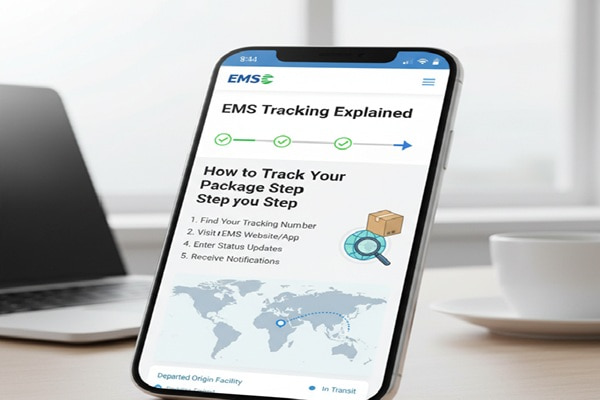
You handed your parcel to the postal worker, got a receipt, and walked out. For the next few days, you and the recipient are both staring at a tracking page waiting for something to change.
That is the EMS tracking experience for most people. Sometimes it updates every few hours. Sometimes it goes silent for a week and you start to panic. Both situations are completely normal, and once you understand how the system actually works, the anxiety disappears.
This guide covers everything you need to know about EMS tracking: how to use it, how to decode your tracking number, what each status means, why updates stop, and how EMS stacks up against private couriers like DHL and FedEx.
What Is EMS and Who Runs It?
EMS stands for Express Mail Service. It is a priority international postal service created by the Universal Postal Union (UPU), the United Nations agency that coordinates global postal policy.
The EMS Cooperative, established in 1998, manages the service across its member nations. Today, EMS connects 176 designated postal operators in more than 180 countries. In practical terms, when you drop a parcel at your national post office marked for EMS delivery, it moves through a chain of national postal services until it reaches the recipient.
In the United States, USPS handles EMS deliveries. In China, it is China Post. In Japan, Japan Post. Each country uses its own postal service for the first and last mile, and the UPU network bridges the gap in between.
How to Track an EMS Package: Step by Step
Tracking an EMS shipment takes about 30 seconds if you have the right number in hand. Here is exactly how to do it.
Step 1: Find Your EMS Tracking Number
Your tracking number appears in three places. Check the physical receipt you received when you dropped off the parcel at the post office. Look for the shipping confirmation email if you ordered from an online retailer. Log into the seller or platform account where the order was placed.
Step 2: Go to a Tracking Portal
You have several reliable options:
- Official EMS website at ems.post, where you enter your number in the tracking field.
- Your national postal service website, such as usps.com for US recipients or japanpost.jp for packages arriving in Japan.
- Third-party aggregators like 17TRACK, AfterShip, TrackingMore, or Ship24, which pull data from multiple carriers simultaneously.
Step 3: Enter the Tracking Number
Type the full 13-character code exactly as it appears on your receipt. One wrong letter or digit will return an error. The system is case-sensitive in some portals, so use capital letters as shown.
Step 4: Read the Results
The results page will show a timeline of every scan event, including location, date, time, and status description. The most recent event appears at the top. You will also see an estimated delivery date, though this is an approximation, not a guarantee.
How to Decode Your EMS Tracking Number
Every EMS tracking number follows the same 13-character structure. Understanding what each part means helps you verify the number is valid before you even start tracking.
| Position | Format | What It Means |
| Characters 1-2 | Two capital letters, starts with E | Service indicator. First letter E confirms it is an EMS shipment. |
| Characters 3-11 | Nine digits | Unique shipment identifier assigned at dispatch. |
| Characters 12-13 | Two capital letters (country code) | ISO country code of the origin country. CN = China, JP = Japan, KR = Korea, US = United States, etc. |
Example: EE123456789JP means it is an EMS Express shipment (EE), unique ID 123456789, sent from Japan (JP).
EMS Tracking Statuses Explained
The status messages on the tracking page can be confusing if you do not know what they mean. Here is a plain-English breakdown of the most common ones.
| Status | What It Means | What to Expect Next |
| Posted / Accepted | The parcel has been handed in and logged at the origin post office. | Departure scan within 24-48 hours. |
| Arrived at Export Office | Package has reached the main outbound exchange facility. | Customs clearance and departure. |
| Presented to Export Customs | Customs is reviewing the package before it leaves the country. | Usually resolves within 24 hours for standard shipments. |
| Dispatched from Outward Office of Exchange | The package has left the origin country. It is in the air or on a ship. | This is the long quiet phase. No updates until it arrives at destination country. |
| Arrived at Inward Office of Exchange | Package has landed in the destination country. | Import customs processing begins. |
| Released from Import Customs | Customs has cleared the package. It is handed to the local postal service. | Out-for-delivery scan within 1-3 business days. |
| Out for Delivery | A local delivery driver has the package on their route today. | Delivery expected same day. |
| Delivered | Package was handed over at the delivery address. | Journey complete. |
How Long Does EMS Delivery Actually Take?
EMS is an express service, but the word express is relative. Delivery time depends heavily on origin country, destination country, customs efficiency, and seasonal volume. Here are realistic timeframes based on common routes.
| Route / Destination | Typical Delivery Time |
| Within the same continent (e.g., within Asia) | 2-5 business days |
| China to United States | 7-14 business days |
| Japan or Korea to United States | 3-7 business days |
| Europe to United States | 5-10 business days |
| Any country to remote destinations | 10-20+ business days |
| During peak seasons (holidays, shopping events) | Add 5-14 days to any estimate |
These are averages. Customs delays, weather, flight connections, and local postal backlogs all affect actual delivery time. EMS does not offer a delivery guarantee the way private couriers like FedEx Priority do.
Why Is Your EMS Tracking Not Updating?
This is the question most people search for, and the answer is almost always: your package is fine, it is just passing through a gap in the scanning network.
The Five Most Common Reasons for Tracking Gaps
- In-transit between major hubs. Scanning only happens at major facilities, not during the journey between them. Your parcel can be on a plane for 12 hours or on a truck for 3 days with zero scans recorded.
- Customs processing. Import and export customs checks can pause tracking for anywhere from 24 hours to several weeks depending on the country and the contents of the package.
- Handover to local postal service. EMS hands off to national carriers at the destination country. If that carrier uses a different scanning system, updates may stop until they scan the parcel in their own network.
- System sync delays. The tracking database takes time to reflect physical scans. During peak shipping periods, this lag can be 24 to 72 hours.
- Weekend and holiday slowdowns. Many postal operations scan less frequently on weekends and public holidays. A tracking blackout over a weekend is normal in almost every country.
What to Do When Tracking Has Stalled
- Check both the origin country EMS portal and the destination country postal service website. Your number works on both, and the destination portal often has more recent scan data.
- Contact the seller or sender and ask them to file an inquiry from their side. They can initiate a formal postal trace with their national EMS operator.
- If customs is the suspected issue, check whether your country requires any additional documentation or duty payment. Some customs portals have their own separate tracking.
- Wait until the 14-day mark for international shipments before filing a formal complaint or opening a dispute with the seller.
EMS vs. DHL vs. FedEx: Which One Should You Use?
The honest answer is: it depends entirely on what you are shipping, where it is going, and how much you want to spend. Here is a clear-eyed comparison.
| Factor | EMS | DHL Express | FedEx International |
| Cost | Lowest (postal rates) | Mid-range | Mid to high |
| Delivery Speed | 3-20+ days depending on route | 1-5 days for most routes | 1-5 days for most routes |
| Tracking Frequency | Checkpoint-based, can have long gaps | Frequent, near real-time | Frequent, near real-time |
| Countries Covered | 180+ | 220+ | 220+ |
| Restricted Items | More lenient (cosmetics, supplements) | Stricter on many categories | Stricter on many categories |
| Weight Limit | Up to 30 kg | Up to 70 kg | Up to 68 kg |
| Insurance | Available (varies by country) | Included up to a limit | Included up to a limit |
| Best For | Budget-conscious shippers, non-urgent items, remote destinations, small packages | Time-sensitive business shipments, Europe-heavy routes | USA-centric business shipments, urgent documents |
| Worst For | Urgent or high-value shipments that need reliable tracking | Budget-sensitive senders | Budget-sensitive senders |
A real-world example: shipping a 2 kg parcel from Singapore to the United States via EMS costs roughly SGD 159 and takes 4-7 working days. DHL Express covers the same route in 3-4 days but costs around SGD 210. For non-urgent personal shipments, EMS saves meaningful money. For a business sending time-sensitive goods, the premium for DHL is often worth it.
Practical Tips That Most Tracking Guides Skip
Most articles tell you to just enter your tracking number and wait. Here are things that actually help when the experience gets complicated.
- Always save your physical receipt. The tracking number printed there is your only proof of shipment if the digital record does not appear immediately.
- Track from both ends. Enter your EMS number on the origin country portal and on the destination country postal website. They often show different events.
- If you are a seller, add the EMS tracking number and the destination country USPS or Royal Mail tracking number separately to your order platform. Some buyers will get better results from one than the other.
- Insure anything valuable. EMS offers insurance in most countries, but you have to request it at the time of shipping. Adding it after the fact is not possible.
- Do not ship restricted items and assume they will pass. Each country has its own customs rules. EMS is more lenient on things like cosmetics and supplements, but lithium batteries, liquids, and food items still face scrutiny.
- If tracking shows delivered but the package has not arrived, check with neighbors and building management first, then contact your local post office with the tracking number before filing a formal claim.
- During Chinese New Year, Golden Week, and December holidays, add 7-14 days to any EMS estimate from Asian countries. These periods create massive backlogs.
Also Read : Saia Tracking: How to Track Your LTL Freight Shipment
Country-Specific EMS Tracking: Where to Look
The official global EMS tracker at ems.post covers the international leg of your shipment. Once the parcel enters the destination country, use these national portals for the most current updates.
| Destination Country | Where to Track | Notes |
| United States | usps.com | Your EMS number works directly on the USPS website. |
| China | ems.com.cn or 17track.net | China Post EMS has its own separate tracking infrastructure. |
| Japan | track.post.japanpost.jp | Japan Post usually provides very detailed scan events. |
| South Korea | ems.epost.go.kr | Korea Post EMS, 0-7 business day domestic delivery. |
| United Kingdom | royalmail.com | Royal Mail handles EMS deliveries in the UK. |
| Australia | auspost.com.au | Australia Post handles inbound EMS. |
| Germany / Europe | deutschepost.de or local national post | DHL/Deutsche Post often handles final mile for EMS in Germany. |
Common Mistakes People Make with EMS Tracking
Avoiding these will save you a lot of unnecessary stress.
- Checking too early. New shipments can take 24-72 hours to appear in the tracking system. A brand new tracking number showing no results does not mean the package was never shipped.
- Only checking one portal. The EMS global tracker may show nothing after the package enters a new country. Always try the destination country postal site.
- Assuming no update means lost package. International shipments routinely go dark for 5-14 days during transit and customs. This is standard, not alarming.
- Mistyping the tracking number. One wrong character returns zero results. Double-check every digit and letter against the original receipt.
- Filing a claim too early. Most postal services require a waiting period before accepting a lost parcel claim: typically 30 days for international shipments. Filing too early wastes your time.
- Forgetting to check for customs notifications. Some countries send separate notifications by post or email when a parcel needs import duties paid. Ignoring these can cause your package to sit in a customs warehouse for weeks.
Frequently Asked Questions About EMS Tracking
What does a valid EMS tracking number look like?
A valid EMS tracking number is 13 characters long. It starts with two capital letters (the first being E), followed by nine digits, and ends with a two-letter country code for the origin country. Example: EE987654321JP for a package sent from Japan. If your number has a different format, verify it with the sender.
How long does it take for EMS tracking to start showing updates?
For most shipments, the first scan appears within 24 to 48 hours after the package is accepted at the post office. Some origin country postal systems can take up to 3 days to register the first event in the tracking database.
Why does my EMS tracking show no updates after leaving the origin country?
This is the most common tracking gap, and it is completely normal. Once the parcel is loaded onto an aircraft or ship, there are no scanning devices in transit. The next update typically appears when the package arrives at the destination country exchange office or clears customs. This silence can last 3 to 14 days depending on the route.
Can I track an EMS package from China using the USPS website?
Yes. If your EMS shipment is being delivered to the United States, the EMS tracking number works directly on usps.com. USPS handles the final delivery leg for all EMS shipments arriving in the US, and their system will show domestic scan events that may not appear on the global EMS tracker.
What is the difference between EMS and ePacket?
ePacket is a lighter, cheaper variation of EMS introduced for small e-commerce packages, primarily from China and Hong Kong. It is limited to packages under 2 kg and lower declared values, and is designed specifically for online retail. Standard EMS handles a wider range of package sizes, weights, and contents up to 30 kg.
Is EMS cheaper than DHL for international shipping?
Generally yes. EMS operates through national postal networks which keeps costs lower than private courier companies like DHL or FedEx. The trade-off is less consistent delivery times and less frequent tracking updates. For non-urgent shipments and budget-sensitive senders, EMS offers good value. For time-sensitive or high-value shipments, the premium for DHL or FedEx is usually justified.
What should I do if my EMS package shows delivered but I have not received it?
First, check with everyone at the delivery address including neighbors or building security. Then contact your local post office with the tracking number to ask whether it was left somewhere or returned. If the issue is not resolved, file a formal inquiry with the national postal service handling delivery in your country. Keep all documentation including your tracking number, order confirmation, and any communication with the sender.
How do I contact EMS customer service if my package is stuck?
The EMS Unit itself does not handle individual customer inquiries. Contact the EMS operator in the origin country (where the package was sent from) or in the destination country (where you are receiving it). Their contact details are on each national postal service website. Have your 13-digit tracking number ready when you call or write.
Does EMS deliver on weekends?
This depends on the country. EMS operates on business days for most of its network and does not deliver on weekends in most countries. Some national postal services do offer Saturday delivery as part of their EMS service, but Sunday delivery is rare. During peak seasons, some services extend their delivery windows.