
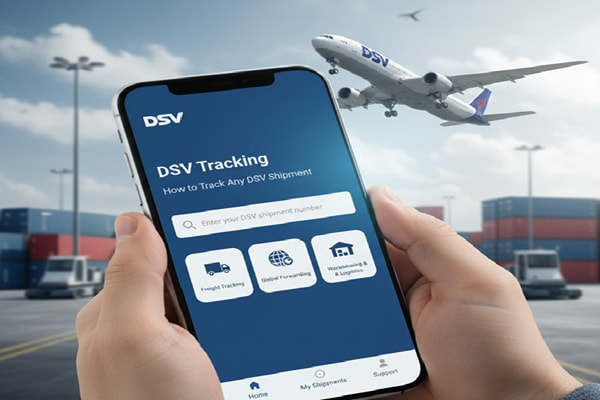

Most carriers give you one tracking number and one website. DSV gives you up to five different reference types across four modes of transport, two separate portals, and the option to use third-party aggregators on top.
Track Your Order
That is not a flaw. It reflects how DSV operates. They are not a parcel courier. They are one of the world’s three largest freight forwarders, moving everything from small business shipments to full container loads of industrial equipment across 80-plus countries.
This guide cuts through all of that. Whether you are tracking a road freight pallet in Europe, a sea container from Asia, an air freight shipment with a tight deadline, or a small parcel through DSV Xpress, every method is covered here in plain language.
What Is DSV? A Quick Background That Matters for Tracking
DSV was founded in 1976 in Denmark by nine independent hauliers. The full original name, De Sammensluttede Vognmaend af 13-7 1976, roughly translates to The Joint Hauliers of 13 July 1976. Today, DSV employs over 75,000 people globally and handles roughly 1.3 million TEUs of sea freight and 600,000 tonnes of air freight per year.
In 2024, DSV completed its acquisition of DB Schenker, making it the largest logistics company in the world by revenue. This is relevant to tracking because both DSV and Schenker systems now operate under the same corporate umbrella, and some Schenker portal links redirect to DSV infrastructure.
DSV does not own ships or aircraft. It works through a global network of partner carriers, which means tracking sometimes passes through third-party systems before returning to DSV’s own platform. Understanding this explains why some tracking gaps happen.
The Two Main DSV Tracking Portals
1. myDSV (mydsv.com) – Primary Portal
myDSV is the central platform for all DSV tracking, booking, and document management. It covers road, air, sea, and Xpress shipments in one interface.
Basic tracking on myDSV requires no account. You enter your reference number and get shipment status, location milestones, and estimated delivery. For full functionality including document downloads, shipment reports, and customs paperwork, you need a registered myDSV account.
2. Schenker Connect (Previously eSchenker)
Following the DB Schenker acquisition, some legacy Schenker customers may still see references to Schenker Connect or eSchenker. These portals now integrate with DSV infrastructure, and Schenker’s track-and-trace URL redirects accordingly. If you are a former DB Schenker customer, use your existing credentials or contact DSV support to migrate to myDSV.
How to Track a DSV Shipment: Step by Step
Step 1: Locate Your Reference Number
DSV tracking uses different reference types depending on the mode of transport. The table below shows which number to use for each shipment type.
| Shipment Type | Reference to Use | Where to Find It |
| Air Freight | AWB (Air Waybill) number | Booking confirmation email or shipping documents |
| Sea Freight (FCL/LCL) | Bill of Lading (B/L) or container number | Sea freight booking confirmation |
| Road Freight (Europe) | Booking reference, CMR or PRO number | Road freight booking confirmation or CMR document |
| Parcel / Xpress | Parcel tracking number (16-digit format) | Label on the package or shipping notification email |
| Any mode | Customer reference number | Your own internal order or PO number if registered with DSV |
Step 2: Go to the Correct Tracking Page
Open mydsv.com in any browser. You do not need to log in for a basic status check. The track and trace search bar is visible on the homepage. For direct access, go to mydsv.com/track-shipment.
Step 3: Enter Your Reference and Search
- Type or paste your reference number into the search field
- If prompted, select the reference type from the dropdown
- Click the search or track button
- Review the shipment status, event timeline, and estimated delivery date
Step 4: Log In for Advanced Details (Optional)
A free myDSV account unlocks several additional features beyond basic tracking. These include downloadable shipping documents such as the Bill of Lading and commercial invoice, real-time exception alerts by email or SMS, and access to historical shipment data and reports. If you regularly ship with DSV, the registered account is worth setting up.
DSV Tracking by Mode of Transport
Air Freight Tracking
DSV moves approximately 600,000 tonnes of air freight per year. Air freight tracking uses the Air Waybill number, which is an 11-digit numeric code assigned when the shipment is booked. This number is the primary reference for all events from pickup through to delivery.
Air freight tracking on myDSV shows departure and arrival airports, customs clearance status, and the handoff to the final-mile carrier in the destination country. Standard international air freight with DSV typically delivers within 2 to 5 business days, depending on origin and destination.
Sea Freight Tracking (FCL and LCL)
Sea freight shipments are tracked by Bill of Lading number or container number. The Bill of Lading is the master document for a sea shipment and serves as both a contract of carriage and a tracking reference.
For Full Container Load shipments, you can also track using the container number directly. For Less than Container Load cargo, where your goods share space with other shippers’ cargo, tracking is tied to the B/L number.
Sea freight transit times vary significantly by route. A Shanghai to Rotterdam shipment typically takes 28 to 35 days. A transpacific US West Coast route runs roughly 14 to 18 days. DSV provides an LCL Sailing Schedule tool on myDSV that shows upcoming departures and estimated transit times by port pair.
| Route | Typical Transit Time | Tracking Reference |
| Asia to Europe (FCL) | 28 to 35 days | Bill of Lading or container number |
| Asia to US West Coast | 14 to 18 days | Bill of Lading or container number |
| Asia to US East Coast | 22 to 28 days | Bill of Lading or container number |
| Europe to US | 10 to 14 days | Bill of Lading or container number |
| Intra-Europe (LCL) | 5 to 10 days | Bill of Lading number |
Road Freight Tracking (Europe)
DSV operates one of the largest road freight networks in Europe with over 19,000 trucks. Road shipments are tracked using the booking reference number, CMR consignment note number, or a PRO number assigned at pickup.
A key advantage of DSV road freight is GPS tracking on all trucks and trailers. This means tracking updates are more frequent than air or sea freight, and location data is essentially continuous during transit. Events appear on myDSV as the truck moves through DSV’s European hub network.
European road freight transit times range from 1 to 7 business days depending on origin and destination. Cross-border shipments may show a brief pause in updates during border crossing and customs processing.
DSV Silkway Express: China to Europe Road Bridge
DSV operates the Silkway Express, a road freight service running between China and Europe with door-to-door transit times of 14 to 18 days. This is an important middle option between air freight and sea freight in both cost and speed.
Silkway Express shipments are tracked on myDSV. All trucks on this route are sealed and GPS-equipped, giving customers visibility throughout the journey. Unlike sea freight, there is no vessel schedule to worry about. DSV collects cargo whenever it is ready.
DSV Xpress Parcel Tracking
DSV Xpress is the express courier division handling smaller parcels and time-critical shipments. Parcel tracking numbers in the Xpress system are typically 16-digit numeric codes. These are trackable on myDSV with more granular scan events than freight shipments, including pickup, in-transit scans, out for delivery, and delivery confirmation.
DSV Xpress Economy delivers to most European destinations in 4 to 5 business days. Express options are faster depending on origin and destination pairing.
DSV Tracking Statuses: What Each One Means
DSV uses standardized status language across its tracking platform. Here is what each status actually means in practical terms.
| Status | What It Means | Next Step |
| Shipment Booked | Booking created but cargo not yet physically collected | Wait for pickup confirmation |
| Picked Up / Collected | DSV or its partner has physically collected the cargo | Expect in-transit updates soon |
| Arrived at Origin Hub | Cargo is at DSV’s sorting or consolidation facility | Clearance and onward routing in progress |
| Export Customs Cleared | Shipment has cleared export customs in origin country | Departure event expected shortly |
| Departed Origin | Cargo has left the origin country (air/sea/road) | Begin tracking against transit time estimate |
| In Transit | Shipment is moving toward destination. No intermediate scan required | Normal. Allow transit time to elapse |
| Arrived at Destination Port/Hub | Cargo has reached the destination country | Customs clearance is next |
| Import Customs Cleared | Cleared through destination country customs | Last-mile delivery is imminent |
| Out for Delivery | Local delivery agent has the package on a route | Delivery expected same day |
| Delivered | Confirmed delivery at destination address | Check proof of delivery if needed |
| Exception / Delay | An issue has been flagged in the system | Check details and contact DSV if no update within 24 hours |
| Pending | DSV is updating routing information for the shipment | Allow 12 to 24 hours for system to refresh |
DSV Tracking Not Updating? Here Are the Real Reasons
The most common support question about DSV is why tracking appears to stop moving. In nearly every case, there is a logical explanation. Here are the most frequent causes.
Partner Carrier Handoff Lag
DSV does not own aircraft or cargo ships. When a shipment moves by air or sea, it is handled by a partner carrier. That partner’s scan data sometimes takes 24 to 48 hours to feed back into DSV’s tracking system. This is particularly common at the moment of departure from origin or arrival at destination.
International Transit Has No Intermediate Scans
A container crossing the Pacific Ocean will show no tracking events for the duration of the voyage. A pallet flying from Singapore to Frankfurt gets scanned at origin and destination, not at 35,000 feet. Gaps of several days during sea transit and 12 to 24 hours during air transit are completely normal.
Infrequent Road Routes in Some Regions
DSV’s road network is dense in Europe but thinner in other regions. In areas where DSV runs delivery routes two or three times per week rather than daily, a shipment may sit at a local hub awaiting the next available route departure. This is normal and does not indicate a problem.
Missed Scan at a Node
In high-volume sorting facilities, individual items occasionally miss a scan. The shipment is still physically moving but tracking does not register the event. The next scan at a downstream facility usually resolves the gap retroactively.
Customs Hold at Destination
If your shipment is held for customs inspection at the destination country, tracking may show Arrived at Destination Port or a similar status for several days with no change. Customs holds are more common for shipments with incomplete documentation, non-standard goods, or shipments flagged for random inspection. Contact DSV with the tracking number and they can confirm whether a customs hold is in place.
| When to Actually Take Action
If your tracking has shown zero movement for more than 3 business days on a road shipment, 5 business days on an air shipment, or 10 business days on a sea shipment after the last confirmed event, contact DSV customer support. Provide your reference number and the last confirmed tracking event. Do not wait past the estimated delivery date before contacting them. |
DSV Tracking Troubleshooting Checklist
- Confirm you are using the correct reference type for your shipment mode (AWB for air, B/L for sea, CMR or booking reference for road).
- Check the reference number for typos. A single incorrect digit returns no results.
- Try tracking on mydsv.com directly rather than a third-party site for the most current data.
- If no result appears, allow up to 48 hours after booking creation. New shipments take time to register.
- Cross-check on a third-party tool such as 17track.net or trackingmore.com, which may catch scan events DSV’s own portal has not yet processed.
- Identify the last confirmed event and assess whether the gap is consistent with normal transit time for that mode and route.
- If the status is Pending, wait 12 to 24 hours. This usually means DSV is internally rerouting or updating delivery information.
- If the shipment is showing Arrived at Destination but no customs clearance update for more than 3 business days, call DSV’s local country office or your freight forwarder to initiate a customs trace.
- If the estimated delivery date has passed with no delivery or update, contact DSV customer service with your reference number and last known event.
- For myDSV account users, check the Exceptions dashboard. DSV flags delays and issues here before they are reflected in the public tracking view.
What a myDSV Account Unlocks That Basic Tracking Does Not
Free registration on myDSV gives access to a substantially more useful set of tracking tools than anonymous tracking. Here is what you gain:
- Real-time exception alerts by email or SMS when a shipment is delayed, held at customs, or requires action
- Downloadable shipping documents including Bill of Lading, commercial invoice, certificate of origin, and packing list
- Historical shipment data and reports by date range, route, or service type
- An exceptions dashboard that surfaces problems before they affect delivery
- Booking management including new bookings, pickups, and delivery scheduling
- eVisibility, DSV’s advanced supply chain visibility tool for businesses with high shipment volumes
- Warehouse Management System visibility for customers using DSV contract logistics
- API and EDI integration access for businesses wanting to embed DSV tracking data in their own systems
For businesses regularly shipping with DSV, the account registration takes less than five minutes and is free. The document download feature alone saves significant time for finance and compliance teams.
Third-Party DSV Tracking Tools Worth Knowing
Several third-party tracking aggregators support DSV tracking numbers and sometimes surface additional scan data or more user-friendly interfaces. These are especially useful when myDSV is temporarily unavailable or when you need to track multiple carriers in one place.
| Tool | Best For | URL |
| 17Track | Multi-carrier tracking in one search, free | 17track.net |
| TrackingMore | API access for developers and businesses | trackingmore.com |
| AfterShip | E-commerce businesses needing post-purchase tracking | aftership.com |
| Parcels App | Mobile tracking across carriers including DSV | parcelsapp.com |
| GoComet | Sea container tracking with analytics | gocomet.com |
| track.global | Multi-modal DSV tracking alternative | track.global |
Note: Third-party tools pull data from DSV’s system via API. They are generally accurate but may lag behind the official myDSV portal by a few hours during peak periods.
DSV Tracking vs Competitors: How It Compares
How does DSV’s tracking capability compare to other major freight forwarders? Here is a practical comparison:
| Provider | Portal | Real-Time GPS | Multi-Mode | Document Access | API |
| DSV (myDSV) | mydsv.com | Road only | Air/Sea/Road/Rail | Yes (account) | Yes |
| DHL Global Forwarding | dhl.com | Limited | Air/Sea/Road | Yes (account) | Yes |
| Kuehne + Nagel | myknconnect.com | Limited | Air/Sea/Road | Yes (account) | Yes |
| Expeditors | expeditors.com | No | Air/Sea/Road | Yes (account) | Yes |
| Flexport | app.flexport.com | Yes | Air/Sea/Road | Yes | Yes |
DSV’s GPS tracking on all road trucks is a genuine advantage over most freight forwarder competitors, who rely on milestone scans rather than continuous location data for road shipments.
Mistakes People Make When Tracking DSV Shipments
Using the Wrong Reference Type
The most common error is entering a sea freight Bill of Lading number into the air freight search field, or using a booking number for a shipment that has already been assigned an AWB. If tracking returns no result, confirm which type of reference you have and match it to the correct shipment mode.
Expecting Parcel-Level Scan Frequency on Freight Shipments
DSV is primarily a freight forwarder, not a parcel courier. Air and sea freight shipments update at major milestones, not every few hours. If you are accustomed to checking Amazon or DHL Express parcels multiple times daily, adjust your expectations for freight tracking. One or two updates per day on active legs is normal. Zero updates during ocean transit is also normal.
Relying Solely on a Third-Party Tool
Third-party aggregators are useful but occasionally show stale data. Before escalating a delay concern to customer service, always verify on myDSV directly. The official portal has the most current status.
Not Setting Up Exception Alerts
myDSV allows users to set up automatic alerts for shipment exceptions. Most customers only discover a customs hold or delivery failure when they manually check tracking. Setting up alerts means you learn about problems immediately instead of days later.
Contacting the Wrong Office
DSV operates in over 80 countries, each with its own country office and support team. When a shipment is in customs in Germany, the relevant team is DSV Germany, not the origin country office. Always contact the country office where the shipment currently is, not where it originated.
Also Read : SpeedPAK Tracking: How to Track Your Package Step by Step
How to Contact DSV for Tracking Support
DSV does not publish a single global customer support number. Support is handled at the country level. Here is how to find the right contact:
- Go to dsv.com and use the country selector in the top right corner
- Navigate to the Contact or Support section for your country
- For urgent freight issues, call the local DSV office directly rather than using web forms
- For myDSV account issues, use the Help section within the myDSV portal
- For claims including damage or loss, use the eClaims portal within myDSV
| Pro Tip: Always Have These Details Ready Before Calling
Reference number (AWB, B/L, booking, or CMR), shipment origin and destination, commodity description, estimated value, and the last tracking event shown in the system. Having all of this ready cuts support call time significantly. |
DSV Tracking in Practice: Real-World Scenarios
Scenario 1: Automotive Parts Manufacturer Shipping from Germany to the US
A tier-2 automotive supplier in Stuttgart ships components weekly to an assembly plant in Ohio via DSV air freight. Using myDSV with their registered account, the logistics team receives automatic alerts for every shipment, downloads customs documents directly from the portal, and cross-checks ETAs against their production schedule. GPS tracking on the transatlantic leg is not available, but AWB milestone tracking gives sufficient visibility to plan inbound receiving.
Scenario 2: Importer Tracking an LCL Sea Shipment from China
A UK-based importer of consumer electronics ships a regular LCL container from Shenzhen to Felixstowe. The Bill of Lading number gives them access to vessel departure, estimated arrival, and customs clearance status on myDSV. They use the LCL Sailing Schedule to plan around departure windows and set exception alerts to catch any customs hold at UK border.
Scenario 3: Freight Broker Monitoring Multiple Road Shipments Across Europe
A third-party logistics provider in Warsaw manages road freight movements for several clients across Poland, Germany, and France. Using the myDSV customer reference feature, they track all active shipments on a single dashboard filtered by their own PO numbers. GPS updates from sealed DSV trucks give near-real-time location data for high-value loads.
Frequently Asked Questions
What is the DSV tracking website?
The primary DSV tracking portal is mydsv.com. You can access the direct tracking page at mydsv.com/track-shipment. No account is required for basic shipment status checks. The legacy tracktrace.dsv.com address also redirects to myDSV.
What tracking number format does DSV use?
DSV uses different reference formats depending on the shipment type. Air freight uses an 11-digit AWB number. Sea freight uses a Bill of Lading number or standard container number format such as ABCU1234567. Road freight uses booking reference or CMR numbers. Parcel and Xpress shipments use a 16-digit numeric tracking number such as 1034501234567890.
Why is my DSV tracking not showing any updates?
The most common reasons are: the shipment is in international transit with no intermediate scans, there is a 24 to 48 hour lag from a partner carrier handoff, the shipment is at a customs checkpoint awaiting clearance, or there was a missed scan at a handling facility. Allow time appropriate to the mode of transport before escalating. For sea freight, gaps of several days during ocean transit are completely normal.
Does DSV have GPS tracking on all shipments?
GPS tracking is standard on all DSV road trucks and trailers in Europe, giving near-continuous location data for road freight. Air and sea freight shipments are tracked at milestones such as pickup, departure, arrival, and customs clearance rather than via GPS. DSV Xpress parcels are tracked at each scan event.
What is myDSV and do I need an account?
myDSV is DSV’s online platform for booking, tracking, and managing shipments. Basic tracking is available without an account. A free registered account adds access to shipment documents, exception alerts, historical data, reports, and advanced supply chain visibility tools. For businesses shipping regularly with DSV, the account is strongly recommended.
How long does DSV take to deliver?
Delivery times vary by mode and route. Air freight internationally delivers in 2 to 5 business days. Standard European road freight delivers in 1 to 7 business days depending on distance. Sea freight timelines range from 10 to 35 days depending on the route. DSV Xpress Economy delivers in approximately 4 to 5 business days within Europe. DSV Silkway Express road freight from China to Europe takes 14 to 18 days.
Can I track a DSV shipment without a tracking number?
If you have a myDSV account, you can search shipments by customer reference number, which is your own internal PO or order number linked to DSV bookings. Without any reference, contact the sender or seller to obtain the tracking reference. DSV customer support can also assist in locating a shipment if you provide shipment details including origin, destination, estimated booking date, and commodity.
What happened to DB Schenker’s tracking portal?
DSV acquired DB Schenker in 2024. DB Schenker’s eSchenker portal is being integrated into DSV’s systems. Some legacy Schenker customers may still access tracking via the Schenker Connect URL, which now routes through DSV infrastructure. Existing Schenker credentials may still work, but new users should register on myDSV directly.
Does DSV offer a tracking API for businesses?
Yes. DSV provides a tracking API that supports air freight, sea freight, road freight within Europe, rail shipments, and Xpress. The API allows businesses to embed DSV tracking data into their own systems, websites, or logistics platforms. One limitation of DSV’s native API is that it tracks one shipment per request. Third-party APIs like TrackingMore or AfterShip offer batch tracking across multiple DSV shipments simultaneously.
What should I do if DSV shows a package as delivered but I did not receive it?
First check all delivery access points including mailboxes, reception areas, and neighbouring units for parcels left in a safe place. Check the tracking for any Proof of Delivery note or safe-drop location description. Contact DSV customer support in the destination country with your reference number. They can retrieve the delivery confirmation data including driver notes, photos, and GPS delivery coordinates.
Conclusion: Get the Most Out of DSV Tracking
DSV’s tracking system is genuinely powerful once you understand how it is structured. The key is matching the right reference type to the right shipment mode and knowing which portal to use for the level of detail you need.
For most tracking needs, mydsv.com handles everything. For businesses with regular volume, a free myDSV account pays off immediately through exception alerts and document access alone. For developers and logistics platforms, the DSV API provides the integration hook that keeps your own systems current.
And when tracking goes quiet, remember the context. A sea container on a 30-day ocean crossing is not lost. An air pallet during international transit has no scans by design. The silence is part of how global freight actually works.